| Forwarded this email? Subscribe here for more. |
Find the Flow

|
Hello, A Newsletter by Arne Brasseur Sep 22 |
(View in browser) |
Hello,
I prepared most of this newsletter last week, all the sections below, and then got stuck on this top part. Now that we’re a few newsletters in I catch myself overthinking the next one. Trying to find something profound to talk about each time. And as a result, getting stuck.
It reminds me of when I started blogging, just over 20 years ago now. I recently dug up the databases of the old blogs I had, and converted the posts to markdown so I could add them back to my personal site. It’s a bit cringe to go over some of the stuff I wrote as a young twenty-something-year-old, close to graduation. The main thing that struck me looking at them again is how short many of these posts are, sometimes just a link and a paragraph. "Hey, here’s a cool thing."
I had already had a few false starts, publishing one or two things online, before the effort would fizzle out. There’s this wall of self-inflected pressure and expectations to push through, once you’ve posted a few things and you know people are starting to watch. And I remember consciously deciding to just post, whenever I felt like it, without overthinking it. Find a flow, get some momentum. Let’s see what the next one brings!
What I’m up to!
Two weeks left before Clojure/conj 2026! I won’t be there in person, but Nubank asked me to host the Compass app for them, where attendees can find the schedule, sign up for activities, keep track of the people they meet, and follow the live streams. I got the domain "Confpass.me", to act as the home of a hosted, commercial version of Compass. So Conj attendees can find that at conj2026.confpass.me.
Last week I started working on the first major upgrade for Corgi since 2022. Corgi is an Emacs configuration, or more acurately it’s a collection of packages which you can use to put together your own Emacs config. Corgi feels a lot like Spacemacs, but at about one fiftieth the complexity. I’m establishing a new baseline with Emacs 29, which allows me to modernise much of the config, and replace several third party packages with built-ins.
It’s still a work in progress. I’m hoping to do some blog posts and/or videos about this, because I think Corgi has an interesting story that’s worth telling.
I’ve been learning some Janet! Janet is a LISP inspired by Clojure (at least on the syntax level), but with fast native builds, and direct C interop.
The reason I’m using Janet is cause I’m working on a blue-green deployment tool, codenamed Cyan. It’s an idea that’s been swimming around in my head for some time, and which finally started to crystalise. A tool which lets me do zero-downtime deploys, integrating neatly into the systemd machinery, and allowing deploys directly from a git repository. I’ve implemented ad-hoc zero-downtime deployment systems a few times now on client projects, and it’s time I do this properly.
I started out with Clojure and GraalVM native-image, which is amazing technology, but it’s also really tedious to work with. So far, I’m quite enjoying doing it with Janet instead.
I’m about halfway through Power and Progress: Our Thousand-Year Struggle Over Technology and Prosperity by Daron Acemoğlu, Simon Johnson. You may have heard of Acemoğlu from Why Nations Fail. Together with James Robinson the two are also recipients of the 2024 Nobel Price of Economics.
The book is a response to the techno-optimistic stance that technological progress is inherently good. They show that through history, from ancient times, medieval times, through the industrial revolution, and finally in our current age of computing and AI, new and improved technology has often meant lower wages and greater hardship, and that people more broadly benefit from "progress" only when specific political and social countervailing forces are present. It’s good to see such prominent names make this point in a very accessible way. I can only hope this will be read widely in policy circles.
I’m also more slowly making my way through The AI Con by Emily Bender and Alex Hanna. So far not a lot of news (for me) but I’m not that far in.
Finally I’m dipping my toes into Tools for Conviviality (1973) by Ivan Illich. This is not an easy read. Illich was writing at the time of the first oil shock, a time when the economic optimism of the postwar period finally took a nosedive. He is anti-institutionalist to the extreme, rejecting even modern medicine and the school system in a way that is hard to appreciate in 2026. But I do think his writing bears some relevance on our current predicaments. (see also "There’s no such thing as a Just a Tool" in the links below)
Some small quotes:
Certain tools are destructive no matter who owns them … Destructive tools must inevitably increase regimentation, dependence, exploitation, or impotence
And:
The attempt to overwhelm present problems by the production of more science is the ultimate attempt to solve a crisis by escalation
Previous Poll
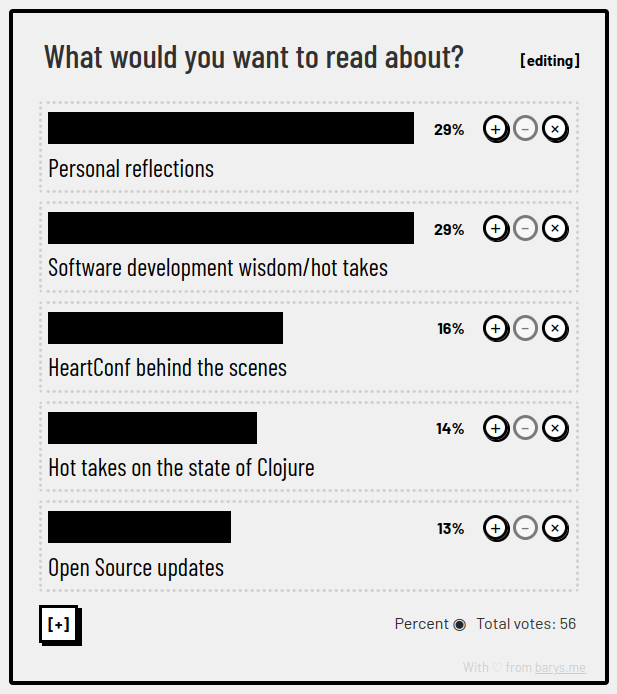
As a warm up round I asked last week what you were interested in reading about in this newsletter. Over a third of recipients filled out the form, which I think is pretty good!
There was one write-in answer, "Hot takes on the state of Clojure", which despite being added later to the poll still got a good few votes. I would have loved to see more write-in answers. Even though this week’s poll is a bit more closed I’m still leaving that option open, feel free to use it!
I’m not sure I have a lot of hot takes on the state of Clojure for the moment, except that it’s still a fantastic language and a vibrant community and ecosystem. But if you voted for that option please do email me and tell me what kind of tea you want me to spill.
The top two results makes me think people are here for my personal ramblings, which is great!
New Poll
This crossed my feed recently: How to use NO as a complete sentence by Mike Monteiro. It took me a moment to realise where I knew that name from, it’s the F*ck you, Pay me guy! What a classic!
The article talks about how the language around AI mirrors that of rape culture, "it’s going to happen anyway, just try to enjoy it", and how the shift to use AI tools is coercive and driven by management, not worker driven.
So this week we’re asking: How is your relationship with AI coding tools?
Do you choose to use them, or have to use them, and do you enjoy using them, or not?
HeartConf
Last Monday I shipped the new HeartConf site! I’m pretty proud of it. I did both the design and implementation (just HTML and CSS). It’s not perfect, and it’ll evolve over the year, but I think it already looks a lot better than the previous two sites (links in the footer if you want to compare).
I wanted to go really bold for this one. Saturated colors, thick lines, bold type. Both to stay far away from the AI design aestethic that all these tools are now defaulting to, and also because these are contentious times, it’s not the time to be timid. In 2019 our biggest concern was how to be inclusive towards underrepresented groups. That still matters, but now we’re also grappling with how to resist our entire industry being remade by a fascist project.
It was important to me to have a site and branding up that really captures the vibe of what I’m going for, before really getting into the weeds of contacting sponsors, speakers, etc. Now the real work can begin.
Take Action
In the EU we’ve all gotten used to those annoying cookie banners, full of dark patterns to coax you into accepting tracking and surveillance. The EU and GDPR often get blamed for this, but they are not the culprit here. There is no mention in EU law of any sort of banner, it merely states that tracking is illegal by default, unless the user has given valid consent — freely given, specific, informed, and unambiguous.
What if you could configure whether you consent to tracking directly in your browser settings? Just like your language preference, this consent flag gets sent along with every request, and the cookie banner would be history. A proposed article 88b of the GDPR would make that happen, but the advertising industry is lobbying hard against it.
If you are in the EU, consider writing to your MPs to tell them where you stand!
Kill the Cookie Banner campaign site
Bookmarks
- VC isn’t VC anymore — understanding the rise of Cancer Capital
- Cancer Capital: VC didn’t use to work like this
- Cancer Capital: It sucks for founders, too!
A three-part series by Anil Dash, about how Venture Capital has changed, becoming an ideological tool, and becoming detached from any rational signals like actual revenue.
Spain has been at the vanguard among its EU peers on several progressive policy areas. It’s also a popular destination for new data centers, due to the availability of energy (Spain is already a renewables powerhouse), and land. Still, we’ve seen in other places that a data center boom will quickly absorb whatever renewables are available, leading to phased out fossil fuel capacity being brought back online, or the building of new fossil fuel power plants. This proposed legislation doesn’t just mandate 80% renewables on average, but every hour, which is much higher bar, and effectively shifts the responsibility for building out sufficient capacity to the data center operators themselves. I’ll be watching this with interest, hopefully this can become a template for other countries or the EU as a whole as well.
Heidegger vs. AI. Criticism of AI, and especially of AI coding tools, is often countered with the phrase "it’s just a tool". Turns out it’s not that simple. Tools shape individuals, society, our worldview, and we should examine them carefully and critically. This one caused quite the discussion when I shared it on Clojure’s Slack community.
If you’re involved with any sort of user group, conference, or any other public event you’re trying to promote, then this is indispensible good advice.
Picture

Last weekend I was volunteering at Cirque Gitan, a circus and music festival organised every two years in the nearby town of Diest. It’s a special place, 100% grass roots. No corporate sponsors whatsoever.
Support
Did you enjoy this email? Share it with a friend!
This is a reader supported publication. Please consider becoming a paid supporter.
